

General Forum, 2023-2027 Term
This is a forum for discussion by Councilmembers of topics relevant to the 2023-2027 Council term.
Only Councilmembers may participate in posting to this internet forum, pursuant to state law.
Please scroll down to view all discussion topics.
This is a forum for discussion by Councilmembers of topics relevant to the 2023-2027 Council term.
Only Councilmembers may participate in posting to this internet forum, pursuant to state law.
Please scroll down to view all discussion topics.
-
Capital Spending Plan Concerns
6 days ago2 ResponsesYou need to be signed in to add your comment.
Sign InThis discussion topic was requested by Council Member Kyonzté Toombs regarding Council Member input on the Capital Spending Plan.
From CM Toombs:
Colleagues, are there any concerns that the proposed CSP doesn't line up (much) with the Council's priority list? I have reviewed the CSP, and departmental needs were prioritized. Most of those needs are mandatory and need to be financed. The Council Priority List largely addresses, obviously, community needs. Those needs also need to be financed because we hear the complaints from our constituents on a daily basis. I know that fulfilling departments' needs leads to better services for residents.
I see 2-3 top 10 priority items in the CSP, and perhaps, some other items can be wrapped into the department needs, such as NDOT's State of Good Repair, Paving, and Traffic Calming budget. There are many requests on the Council list around traffic calming and road repair. I also see lots of requests regarding parks and libraries. My guess is that unless the department is advocating as hard as you are, you won't see that item in the CSP.
Any ideas on how to better align our priority list with the administration's (i.e., departments') priorities, so that the resulting CSP represents a coordinated capital improvement plan for the city? Or are council members satisfied with the process as is? Should we require that the CSP include a certain percentage of "community needs?"
This discussion topic was requested by Council Member Kyonzté Toombs regarding Council Member input on the Capital Spending Plan.
From CM Toombs:
Colleagues, are there any concerns that the proposed CSP doesn't line up (much) with the Council's priority list? I have reviewed the CSP, and departmental needs were prioritized. Most of those needs are mandatory and need to be financed. The Council Priority List largely addresses, obviously, community needs. Those needs also need to be financed because we hear the complaints from our constituents on a daily basis. I know that fulfilling departments' needs leads to better services for residents.
I see 2-3 top 10 priority items in the CSP, and perhaps, some other items can be wrapped into the department needs, such as NDOT's State of Good Repair, Paving, and Traffic Calming budget. There are many requests on the Council list around traffic calming and road repair. I also see lots of requests regarding parks and libraries. My guess is that unless the department is advocating as hard as you are, you won't see that item in the CSP.
Any ideas on how to better align our priority list with the administration's (i.e., departments') priorities, so that the resulting CSP represents a coordinated capital improvement plan for the city? Or are council members satisfied with the process as is? Should we require that the CSP include a certain percentage of "community needs?"
Go to discussionThank you for your contribution!
Help us reach out to more people in the community
Share this with family and friends
No thanks -
BL2026-1450 Substitute
16 days agoYou need to be signed in to add your comment.
Sign InThe following CouncilConnect post was requested by CM Cortese, pertaining to the substitute on BL2026-1450.
From CM Cortese:
Colleagues,
I want to provide some context around BL2026-1450 and the substitute I submitted on Friday.
The Keep Kids Safe Online Act is really about getting ahead of a threat that a lot of parents and families still don’t know exists.
There are violent online networks actively targeting vulnerable young people through social media, gaming platforms, messaging apps and other places where our kids spend time online. They can start by simply befriending a young person and gaining their trust. From there, the FBI has documented the use of manipulation, coercion and blackmail to push kids toward self-harm, sexual exploitation, animal cruelty and, in some cases, violence against others.
And this isn't some abstract threat happening somewhere else. We have seen its potential impact right here in Nashville. Investigators found that the Antioch High School shooter was involved in these online extremist communities and had connections to groups including 764 and Maniac Murder Cult. Investigators have also said they believe online “handlers” were encouraging him toward violence. That tragedy is one of the reasons I believe we need to better understand what is happening in these online spaces.
The numbers are alarming. In 2025, the National Center for Missing & Exploited Children received more than 3,000 reports of sadistic online exploitation involving violent online groups targeting children, an increase of more than 125% from the year before. And as of February 2026, the FBI was investigating more than 450 people nationwide connected to 764-related violent online networks.
What this bill does is pretty straightforward. It brings together the Metropolitan Human Relations Commission, MNPD, the Office of Youth Safety, Metro Schools, Juvenile Court and community partners to raise awareness and make sure parents, educators and young people have better information about what these networks are, how they operate and what warning signs to look for so they have a better chance to intervene before a situation escalates.
And this isn't a static threat. Technology changes quickly, and so do the platforms, terminology and tactics these groups use. This initiative is designed to evolve with those threats, keeping our families, schools, law enforcement and youth-serving agencies informed as the threat changes.
This isn't about creating a new enforcement mechanism. It's about putting the right people around the table, sharing information across agencies, and building an ongoing public awareness initiative to help improve prevention and make sure Metro can keep pace as these threats and tactics evolve.
Mike
The following CouncilConnect post was requested by CM Cortese, pertaining to the substitute on BL2026-1450.
From CM Cortese:
Colleagues,
I want to provide some context around BL2026-1450 and the substitute I submitted on Friday.
The Keep Kids Safe Online Act is really about getting ahead of a threat that a lot of parents and families still don’t know exists.
There are violent online networks actively targeting vulnerable young people through social media, gaming platforms, messaging apps and other places where our kids spend time online. They can start by simply befriending a young person and gaining their trust. From there, the FBI has documented the use of manipulation, coercion and blackmail to push kids toward self-harm, sexual exploitation, animal cruelty and, in some cases, violence against others.
And this isn't some abstract threat happening somewhere else. We have seen its potential impact right here in Nashville. Investigators found that the Antioch High School shooter was involved in these online extremist communities and had connections to groups including 764 and Maniac Murder Cult. Investigators have also said they believe online “handlers” were encouraging him toward violence. That tragedy is one of the reasons I believe we need to better understand what is happening in these online spaces.
The numbers are alarming. In 2025, the National Center for Missing & Exploited Children received more than 3,000 reports of sadistic online exploitation involving violent online groups targeting children, an increase of more than 125% from the year before. And as of February 2026, the FBI was investigating more than 450 people nationwide connected to 764-related violent online networks.
What this bill does is pretty straightforward. It brings together the Metropolitan Human Relations Commission, MNPD, the Office of Youth Safety, Metro Schools, Juvenile Court and community partners to raise awareness and make sure parents, educators and young people have better information about what these networks are, how they operate and what warning signs to look for so they have a better chance to intervene before a situation escalates.
And this isn't a static threat. Technology changes quickly, and so do the platforms, terminology and tactics these groups use. This initiative is designed to evolve with those threats, keeping our families, schools, law enforcement and youth-serving agencies informed as the threat changes.
This isn't about creating a new enforcement mechanism. It's about putting the right people around the table, sharing information across agencies, and building an ongoing public awareness initiative to help improve prevention and make sure Metro can keep pace as these threats and tactics evolve.
Mike
Thank you for your contribution!
Help us reach out to more people in the community
Share this with family and friends
No thanks -
RS2026-2324
19 days agoYou need to be signed in to add your comment.
Sign InThe following discussion topic has been requested by CM Cortese, regarding Resolution No. RS2026-2324 and flight paths from BNA.
From CM Cortese:
Colleagues,
I hope you're all well. I wanted to provide a little context on RS2026-2324 and what I’m hoping to accomplish with it.
First, this is not an attack on the Airport Authority. The FAA controls flight paths, and I’ve been clear with residents about the limits of what Metro or MNAA can do. The purpose of this resolution is to add our voice to the work already being done and make sure the FAA understands how these changes are affecting people on the ground.
Some neighbors in my area report going from flights in the single digits each day to more than 150. Residents have also reported noise readings exceeding 90 dB. I’ve personally stood in neighbors’ driveways where we’ve had to stop a conversation entirely until a plane passed.
I also want to be clear that this is not about moving the problem from one neighborhood to another. Safety has to come first, but where mitigation efforts are available, we should be looking for ways to reduce the impact on all of our communities rather than simply shifting that impact somewhere else. I think there is real value in us standing together as a Council on that principle. It sends the message that we don’t want one set of communities disproportionately affected when reasonable mitigation options may be available. That could include measures such as higher departure altitudes over residential areas where safely and operationally feasible, along with a more equitable distribution of unavoidable impacts. I’m happy to add language to the resolution that is very explicit about that.
Even if this resolution produces no immediate response from the FAA, I believe there is value in putting these impacts on the record. Nashville will continue to grow, air traffic will increase, and flight patterns will continue to evolve. Making sure the FAA understands the extent of what residents in the impacted areas are experiencing today gives them important information to consider when flight plans are reviewed or changed in the future.
I’m happy to defer the resolution and work with colleagues on language that makes these goals even more clear. Ultimately, I want Metro to be a partner in this process and help ensure that MNAA and the FAA have reliable, on-the-ground information about how flight patterns are affecting our communities. As Nashville continues to grow and future plans are considered, I believe that perspective can help inform decisions that protect safety while reducing impacts on our neighborhoods wherever possible.
Mike
The following discussion topic has been requested by CM Cortese, regarding Resolution No. RS2026-2324 and flight paths from BNA.
From CM Cortese:
Colleagues,
I hope you're all well. I wanted to provide a little context on RS2026-2324 and what I’m hoping to accomplish with it.
First, this is not an attack on the Airport Authority. The FAA controls flight paths, and I’ve been clear with residents about the limits of what Metro or MNAA can do. The purpose of this resolution is to add our voice to the work already being done and make sure the FAA understands how these changes are affecting people on the ground.
Some neighbors in my area report going from flights in the single digits each day to more than 150. Residents have also reported noise readings exceeding 90 dB. I’ve personally stood in neighbors’ driveways where we’ve had to stop a conversation entirely until a plane passed.
I also want to be clear that this is not about moving the problem from one neighborhood to another. Safety has to come first, but where mitigation efforts are available, we should be looking for ways to reduce the impact on all of our communities rather than simply shifting that impact somewhere else. I think there is real value in us standing together as a Council on that principle. It sends the message that we don’t want one set of communities disproportionately affected when reasonable mitigation options may be available. That could include measures such as higher departure altitudes over residential areas where safely and operationally feasible, along with a more equitable distribution of unavoidable impacts. I’m happy to add language to the resolution that is very explicit about that.
Even if this resolution produces no immediate response from the FAA, I believe there is value in putting these impacts on the record. Nashville will continue to grow, air traffic will increase, and flight patterns will continue to evolve. Making sure the FAA understands the extent of what residents in the impacted areas are experiencing today gives them important information to consider when flight plans are reviewed or changed in the future.
I’m happy to defer the resolution and work with colleagues on language that makes these goals even more clear. Ultimately, I want Metro to be a partner in this process and help ensure that MNAA and the FAA have reliable, on-the-ground information about how flight patterns are affecting our communities. As Nashville continues to grow and future plans are considered, I believe that perspective can help inform decisions that protect safety while reducing impacts on our neighborhoods wherever possible.
Mike
Thank you for your contribution!
Help us reach out to more people in the community
Share this with family and friends
No thanks -
No Right Turn on Red
20 days agoYou need to be signed in to add your comment.
Sign InThis discussion topic was requested by Council Member Burkley Allen regarding BL2026-1497, regulating right turns on red. This topic links to a map created by NDOT to show the proposed intersections for no right turn on red by BL2026-1497, as substituted.
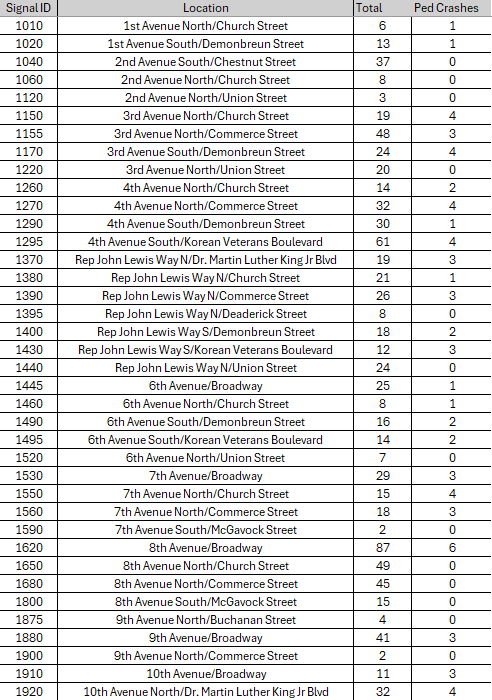
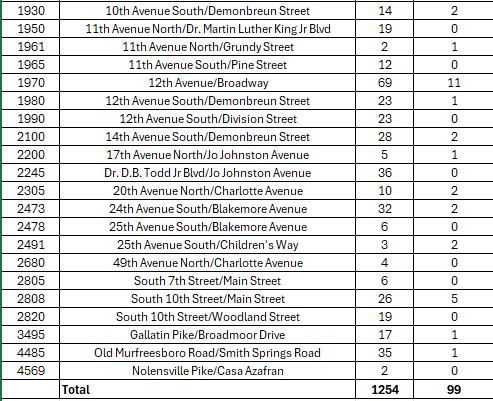
This crash data covers a five-year period, from September 2021 through September 2026, across the 59 identified intersections. During this period, the crash data shows a total of 1,254 crashes, including 99 crashes involving pedestrians. I have also attached a map showing the 59 signalized intersections included in the No Right on Red (NROR) substitution.
This discussion topic was requested by Council Member Burkley Allen regarding BL2026-1497, regulating right turns on red. This topic links to a map created by NDOT to show the proposed intersections for no right turn on red by BL2026-1497, as substituted.
This crash data covers a five-year period, from September 2021 through September 2026, across the 59 identified intersections. During this period, the crash data shows a total of 1,254 crashes, including 99 crashes involving pedestrians. I have also attached a map showing the 59 signalized intersections included in the No Right on Red (NROR) substitution.
Thank you for your contribution!
Help us reach out to more people in the community
Share this with family and friends
No thanks -
You need to be signed in to add your comment.
Sign InThis discussion topic was requested by Council Member Zulfat Suara regarding NLC Virtual Policy Sprint Workshop.
From CM Suara:
Colleagues,
I want to highlight the email Director Wilson shared on September 23 about the upcoming Compass training offered by the National League of Cities. I strongly encourage you to take part in this two-part workshop. it’s a unique opportunity to strengthen how we, as a Council, develop policy solutions that truly meet the needs of our residents.
Many of you will remember that funding for the PILOT program was discussed during our budget work sessions. Thanks to the Vice Mayor’s efforts, it was ultimately included in the current budget. This training is part of that investment.
The idea to pursue the Compass came from a colleague who wished she understood more about our policy development process, and I suspect most of us have felt this way at some point. Vice Mayor Angie Henderson, Director Wilson, Ms. Harrell, and I have since worked closely with NLC to bring this resource to Nashville. It’s something we haven’t had available before, and it will benefit all of us, as well as future council members.
The workshop aims to:
- Offer training or a refresher for current council members.
- Serve as a PILOT that will help shape what becomes part of the onboarding process for new members.
I truly hope you’ll participate. As the legislative arm of Metro Government, our core responsibility is developing policy that serves our residents well. This workshop gives us a chance to come together, deepen our understanding of the policy process, and strengthen how we work. For colleagues who are term-limited or not seeking re-election, your experience is especially valuable. Your insights into what works well and what doesn’t will directly shape a stronger program for the next cohort of council members.
Serving on the Metro Council is uniquely challenging and uniquely rewarding. Very few people outside this body understand the work the way you do. This workshop is a rare chance to learn, reflect, and share your expertise with one another.
Please find the links to an event flyer and the registration form.
Workshop Description from NLC:
Local policy development requires balancing competing priorities, navigating complex systems, and turning ideas into action. The National League of Cities and the Urban Institute developed the Compass to help local policymakers identify the right policy approach at the right moment. In this interactive workshop, you’ll apply the Compass framework through hands-on activities with fellow Council Members.Thank you all for all that you do!
This discussion topic was requested by Council Member Zulfat Suara regarding NLC Virtual Policy Sprint Workshop.
From CM Suara:
Colleagues,
I want to highlight the email Director Wilson shared on September 23 about the upcoming Compass training offered by the National League of Cities. I strongly encourage you to take part in this two-part workshop. it’s a unique opportunity to strengthen how we, as a Council, develop policy solutions that truly meet the needs of our residents.
Many of you will remember that funding for the PILOT program was discussed during our budget work sessions. Thanks to the Vice Mayor’s efforts, it was ultimately included in the current budget. This training is part of that investment.
The idea to pursue the Compass came from a colleague who wished she understood more about our policy development process, and I suspect most of us have felt this way at some point. Vice Mayor Angie Henderson, Director Wilson, Ms. Harrell, and I have since worked closely with NLC to bring this resource to Nashville. It’s something we haven’t had available before, and it will benefit all of us, as well as future council members.
The workshop aims to:
- Offer training or a refresher for current council members.
- Serve as a PILOT that will help shape what becomes part of the onboarding process for new members.
I truly hope you’ll participate. As the legislative arm of Metro Government, our core responsibility is developing policy that serves our residents well. This workshop gives us a chance to come together, deepen our understanding of the policy process, and strengthen how we work. For colleagues who are term-limited or not seeking re-election, your experience is especially valuable. Your insights into what works well and what doesn’t will directly shape a stronger program for the next cohort of council members.
Serving on the Metro Council is uniquely challenging and uniquely rewarding. Very few people outside this body understand the work the way you do. This workshop is a rare chance to learn, reflect, and share your expertise with one another.
Please find the links to an event flyer and the registration form.
Workshop Description from NLC:
Local policy development requires balancing competing priorities, navigating complex systems, and turning ideas into action. The National League of Cities and the Urban Institute developed the Compass to help local policymakers identify the right policy approach at the right moment. In this interactive workshop, you’ll apply the Compass framework through hands-on activities with fellow Council Members.Thank you all for all that you do!
Thank you for your contribution!
Help us reach out to more people in the community
Share this with family and friends
No thanks -
BL2026-1514 — Employee Surveys
about 1 month agoYou need to be signed in to add your comment.
Sign InThis discussion topic was requested by Council Member Tasha Ellis regarding Ordinance No. BL2026-1514.
Colleagues,
At yesterday's Government Operations and Regulations Committee meeting, we discussed CM Styles' bill and my proposed substitute. The committee voted on my substitute, which received a favorable vote, and the bill was then deferred one meeting to October 6.
Everyone agrees on the goal: Metro employees should have a meaningful way to provide feedback. The question is how we build a process that employees trust and that produces reliable, actionable information.
WHY THIS MATTERS
As Council members, we often hear about departments from directors and liaisons or from individual employees who reach out when something is already wrong. A well-designed employee survey can give us a broader picture of workplace culture, leadership, morale and other trends before problems reach that point.
But that only works if employees trust the process and the results are collected and interpreted appropriately.
HOW THE TWO VERSIONS DIFFER
Original bill: Requires HR to fund and facilitate annual surveys and establishes the survey structure now. It identifies six specific areas to measure, requires administration by an outside third party, and requests that surveys be anonymous and confidential. However, it directs HR to fund the surveys even though no money has been appropriated. Survey funding was not included in the adopted FY27 budget, and the Council cannot direct mid-year funding on its own.
My substitute: Requires HR, once funding is appropriated, to complete a best-practices study within six months and report back to Council. That study must address survey administration, frequency, anonymity, equitable access, resources, interpretation of results and protections against retaliatory behavior. The six subjects in the original bill remain as potential areas to measure rather than an exhaustive list.
There is also a Charter issue. The Council Office analysis states that the original legislation does not align with Article 12 of the Charter, which assigns responsibility for personnel rules to the Director of Personnel and Civil Service Commission. My substitute is structured around that existing authority while directing HR to develop the framework and bring the results back to Council.
Practically, the earliest funding for either version is the FY28 budget, which begins July 1, 2027. Under my substitute, the study would be completed within six months, so the framework is ready when surveys could realistically begin, not later.
The goal of my substitute is simple: use the time before implementation to build the framework first, so when Metro surveys employees, employees can trust the process and Council receives information we can responsibly use.
I respectfully ask for your support of the substitute on October 6, and I'm glad to answer any questions before then.
This discussion topic was requested by Council Member Tasha Ellis regarding Ordinance No. BL2026-1514.
Colleagues,
At yesterday's Government Operations and Regulations Committee meeting, we discussed CM Styles' bill and my proposed substitute. The committee voted on my substitute, which received a favorable vote, and the bill was then deferred one meeting to October 6.
Everyone agrees on the goal: Metro employees should have a meaningful way to provide feedback. The question is how we build a process that employees trust and that produces reliable, actionable information.
WHY THIS MATTERS
As Council members, we often hear about departments from directors and liaisons or from individual employees who reach out when something is already wrong. A well-designed employee survey can give us a broader picture of workplace culture, leadership, morale and other trends before problems reach that point.
But that only works if employees trust the process and the results are collected and interpreted appropriately.
HOW THE TWO VERSIONS DIFFER
Original bill: Requires HR to fund and facilitate annual surveys and establishes the survey structure now. It identifies six specific areas to measure, requires administration by an outside third party, and requests that surveys be anonymous and confidential. However, it directs HR to fund the surveys even though no money has been appropriated. Survey funding was not included in the adopted FY27 budget, and the Council cannot direct mid-year funding on its own.
My substitute: Requires HR, once funding is appropriated, to complete a best-practices study within six months and report back to Council. That study must address survey administration, frequency, anonymity, equitable access, resources, interpretation of results and protections against retaliatory behavior. The six subjects in the original bill remain as potential areas to measure rather than an exhaustive list.
There is also a Charter issue. The Council Office analysis states that the original legislation does not align with Article 12 of the Charter, which assigns responsibility for personnel rules to the Director of Personnel and Civil Service Commission. My substitute is structured around that existing authority while directing HR to develop the framework and bring the results back to Council.
Practically, the earliest funding for either version is the FY28 budget, which begins July 1, 2027. Under my substitute, the study would be completed within six months, so the framework is ready when surveys could realistically begin, not later.
The goal of my substitute is simple: use the time before implementation to build the framework first, so when Metro surveys employees, employees can trust the process and Council receives information we can responsibly use.
I respectfully ask for your support of the substitute on October 6, and I'm glad to answer any questions before then.
Thank you for your contribution!
Help us reach out to more people in the community
Share this with family and friends
No thanks -
Dr. Ouida Davis for Health and Educational Facilities Board
about 2 months agoYou need to be signed in to add your comment.
Sign InThis discussion topic was requested by Council Member Jennifer Gamble regarding the Health and Educational Facilities Board nominee Dr. Ouida Davis.
From CM Gamble:
Dear Colleagues,
I’m writing to ask for your support of Dr. Ouida Davis for the Health and Educational Facilities Board. Dr. Davis has over 20 years of experience in social services, specializing in public policy, strategic planning, and program coordination. Prior to retiring from Metro Social Services in April of this year, she coordinated services for individuals facing housing instability, economic uncertainty, and health concerns. She has a doctorate in education, leadership and professional practice and has coordinated programming for adults, seniors, and immigrant populations.
During Dr. Davis’s interview on Aug 18, with the Metro Council Rules, Confirmations, and Public Elections Committee, she talked about how she would bring her experience working with vulnerable populations to the HEFB. She gave an example of how important it is to consider all aspects of family support services when making decisions about how the city finances capital projects, facilities, and housing for qualifying health and educational institutions.
I believe that Dr. Davis will bring a fresh perspective to the Health and Educational Facilities Board, and I ask for your support of her nomination.
This discussion topic was requested by Council Member Jennifer Gamble regarding the Health and Educational Facilities Board nominee Dr. Ouida Davis.
From CM Gamble:
Dear Colleagues,
I’m writing to ask for your support of Dr. Ouida Davis for the Health and Educational Facilities Board. Dr. Davis has over 20 years of experience in social services, specializing in public policy, strategic planning, and program coordination. Prior to retiring from Metro Social Services in April of this year, she coordinated services for individuals facing housing instability, economic uncertainty, and health concerns. She has a doctorate in education, leadership and professional practice and has coordinated programming for adults, seniors, and immigrant populations.
During Dr. Davis’s interview on Aug 18, with the Metro Council Rules, Confirmations, and Public Elections Committee, she talked about how she would bring her experience working with vulnerable populations to the HEFB. She gave an example of how important it is to consider all aspects of family support services when making decisions about how the city finances capital projects, facilities, and housing for qualifying health and educational institutions.
I believe that Dr. Davis will bring a fresh perspective to the Health and Educational Facilities Board, and I ask for your support of her nomination.
Thank you for your contribution!
Help us reach out to more people in the community
Share this with family and friends
No thanks -
Matt Wiltshire for Health and Educational Facilities Board
about 2 months agoYou need to be signed in to add your comment.
Sign InThis discussion topic was requested by Council Member Burkley Allen regarding the Health and Educational Facilities Board nominee Matt Wiltshire.
From CM Allen:
Dear Colleagues,
I am writing to ask for your support for Matt Wiltshire for Health and Education Facilities Board, Matt has already served on this board, fulfilling an unexpired term. He understands the mission of the HEFB as it is spelled out in the Metro Code: to issue revenue bonds and loan the proceeds to finance the acquisition, construction, development, rehabilitation, and improvement of health, educational, and multifamily housing facilities. The types of eligible projects and borrowers are determined by State statute and include hospitals, universities, non-profit schools, and multifamily housing developers.
Matt’s work experience with the Metro Development and Housing Agency (MDHA) and now with Pathway Lending has given him first-hand experience at understanding the complex financing involved in affordable housing finance, and the life changing outcomes from having good housing, healthcare, and educational opportunities. During his campaign for Mayor, Matt focused heavily on education in Nashville and demonstrated his intimate knowledge of our local educational options and the importance of providing every student with a great education.
Matt is a dedicated servant for public good, and I would appreciate your consideration for this position.
This discussion topic was requested by Council Member Burkley Allen regarding the Health and Educational Facilities Board nominee Matt Wiltshire.
From CM Allen:
Dear Colleagues,
I am writing to ask for your support for Matt Wiltshire for Health and Education Facilities Board, Matt has already served on this board, fulfilling an unexpired term. He understands the mission of the HEFB as it is spelled out in the Metro Code: to issue revenue bonds and loan the proceeds to finance the acquisition, construction, development, rehabilitation, and improvement of health, educational, and multifamily housing facilities. The types of eligible projects and borrowers are determined by State statute and include hospitals, universities, non-profit schools, and multifamily housing developers.
Matt’s work experience with the Metro Development and Housing Agency (MDHA) and now with Pathway Lending has given him first-hand experience at understanding the complex financing involved in affordable housing finance, and the life changing outcomes from having good housing, healthcare, and educational opportunities. During his campaign for Mayor, Matt focused heavily on education in Nashville and demonstrated his intimate knowledge of our local educational options and the importance of providing every student with a great education.
Matt is a dedicated servant for public good, and I would appreciate your consideration for this position.
Thank you for your contribution!
Help us reach out to more people in the community
Share this with family and friends
No thanks -
BL2026-1526
about 2 months agoYou need to be signed in to add your comment.
Sign InThe discussion topic was requested by Council Member Tasha Ellis, relative to Ordinance No. BL2026-1526.
BL2026-1526 was deferred two meetings out of Transportation and Infrastructure this evening. Four members had outstanding questions.
For those who have not read it: BL2026-1526 directs NDOT to build a standardized tool for tracking the cumulative transportation impacts of developments and rezonings across the county, rather than assessing each application in isolation. It directs NDOT to coordinate with Planning and other agencies on when an area transportation infrastructure analysis is warranted, and requests that improvements identified through that analysis be considered in future Capital Improvement Budgets. Section 4 leaves the method and thresholds to departmental judgment.
I'd encourage everyone to go back and watch the Transportation and Infrastructure Committee meeting. The discussion is worth hearing in full, and I would rather people form their own view from the recording than from a summary.
Here is why this tool matters. In March 2024, Council passed RS2024-288 asking four questions about housing and infrastructure. Two of them were about whether our infrastructure can carry the growth we were about to allow. We adopted the zoning changes that came out of the first two questions. We are still waiting on full answers to the other two.
Councilmember Druffel has been working with NDOT on this tool for ten months. It does one thing we currently cannot do: measure the cumulative transportation effect of development instead of reviewing each project as if the last one never happened.
There was discussion about broadening the tool to cover stormwater. The bill as written already directs NDOT to coordinate with Planning and other relevant agencies, and it deliberately leaves method and threshold to departmental expertise. Nothing needs to be added for stormwater work to happen.
Quick noteworthy side bar: The Planning Committee chair stated that the outstanding infrastructure study will be complete in the next few weeks. That is the first timeline this Council has been given.
I'd encourage colleagues to read the bill itself ahead of tomorrow night so we can discuss it knowledgeably, including the concerns I've raised here. It is short.
More importantly, do not wait on this. If you have a technical question about what the tool can and cannot do, send it to NDOT through the committee chair so we get an answer on the record. If you think the bill needs an amendment, contact the Council Office now rather than in the week it returns, since amendments have to be filed well ahead of the meeting to be considered. A two-meeting deferral is only useful if we use it. I would rather we arrive at that meeting having established either that no amendments are needed or that we have the right ones drafted and circulated.
The discussion topic was requested by Council Member Tasha Ellis, relative to Ordinance No. BL2026-1526.
BL2026-1526 was deferred two meetings out of Transportation and Infrastructure this evening. Four members had outstanding questions.
For those who have not read it: BL2026-1526 directs NDOT to build a standardized tool for tracking the cumulative transportation impacts of developments and rezonings across the county, rather than assessing each application in isolation. It directs NDOT to coordinate with Planning and other agencies on when an area transportation infrastructure analysis is warranted, and requests that improvements identified through that analysis be considered in future Capital Improvement Budgets. Section 4 leaves the method and thresholds to departmental judgment.
I'd encourage everyone to go back and watch the Transportation and Infrastructure Committee meeting. The discussion is worth hearing in full, and I would rather people form their own view from the recording than from a summary.
Here is why this tool matters. In March 2024, Council passed RS2024-288 asking four questions about housing and infrastructure. Two of them were about whether our infrastructure can carry the growth we were about to allow. We adopted the zoning changes that came out of the first two questions. We are still waiting on full answers to the other two.
Councilmember Druffel has been working with NDOT on this tool for ten months. It does one thing we currently cannot do: measure the cumulative transportation effect of development instead of reviewing each project as if the last one never happened.
There was discussion about broadening the tool to cover stormwater. The bill as written already directs NDOT to coordinate with Planning and other relevant agencies, and it deliberately leaves method and threshold to departmental expertise. Nothing needs to be added for stormwater work to happen.
Quick noteworthy side bar: The Planning Committee chair stated that the outstanding infrastructure study will be complete in the next few weeks. That is the first timeline this Council has been given.
I'd encourage colleagues to read the bill itself ahead of tomorrow night so we can discuss it knowledgeably, including the concerns I've raised here. It is short.
More importantly, do not wait on this. If you have a technical question about what the tool can and cannot do, send it to NDOT through the committee chair so we get an answer on the record. If you think the bill needs an amendment, contact the Council Office now rather than in the week it returns, since amendments have to be filed well ahead of the meeting to be considered. A two-meeting deferral is only useful if we use it. I would rather we arrive at that meeting having established either that no amendments are needed or that we have the right ones drafted and circulated.
Thank you for your contribution!
Help us reach out to more people in the community
Share this with family and friends
No thanks -
You need to be signed in to add your comment.
Sign InThis discussion topic was requested by Council Member Mike Cortese, relative to Resolution No. RS2026-2189.
Colleagues,
I will not be able to attend the Transportation & Infrastructure Committee meeting on Monday. I only have one resolution (RS2026-2189) up for review, and I am comfortable with it running on consent. I did, however, want to provide some context in the event the Chair or any committee members have questions.
I recently attended a graduation for high school students entering our MC3 pre-apprenticeship program and came away with a concern that I believe deserves our attention.
As my colleagues know, MC3 creates a strong pathway into well-paying careers in the skilled trades. But many of these young graduates are expected to provide their own transportation to job sites, which can change from day to day and are often difficult to reach without a vehicle. For students coming from families with limited resources, that can become a barrier to opportunity before their careers even begin.
I approached WeGo to see what options might be available to help close that gap. Their team suggested adding MC3 participants to the Journey Pass Program and has been incredibly receptive to the idea. They are also open to exploring adjustments to the first-mile/last-mile service provided through Uber so it can better align with job sites throughout Davidson County. The WeGo team shares our goal of making sure transportation is never the reason one of these young people misses out on a life-changing opportunity.
We have also begun discussions with the Choose How You Move team in the Mayor’s Office, and they have been very receptive as well.
This resolution is intended to put the Council’s support for MC3, and for expanding the Journey Pass Program to help these students get to work, clearly on the record. We have invested in creating a pathway to good-paying careers. We should do everything reasonably within our power to make sure transportation is not the barrier that keeps a young person from walking through that door.
This discussion topic was requested by Council Member Mike Cortese, relative to Resolution No. RS2026-2189.
Colleagues,
I will not be able to attend the Transportation & Infrastructure Committee meeting on Monday. I only have one resolution (RS2026-2189) up for review, and I am comfortable with it running on consent. I did, however, want to provide some context in the event the Chair or any committee members have questions.
I recently attended a graduation for high school students entering our MC3 pre-apprenticeship program and came away with a concern that I believe deserves our attention.
As my colleagues know, MC3 creates a strong pathway into well-paying careers in the skilled trades. But many of these young graduates are expected to provide their own transportation to job sites, which can change from day to day and are often difficult to reach without a vehicle. For students coming from families with limited resources, that can become a barrier to opportunity before their careers even begin.
I approached WeGo to see what options might be available to help close that gap. Their team suggested adding MC3 participants to the Journey Pass Program and has been incredibly receptive to the idea. They are also open to exploring adjustments to the first-mile/last-mile service provided through Uber so it can better align with job sites throughout Davidson County. The WeGo team shares our goal of making sure transportation is never the reason one of these young people misses out on a life-changing opportunity.
We have also begun discussions with the Choose How You Move team in the Mayor’s Office, and they have been very receptive as well.
This resolution is intended to put the Council’s support for MC3, and for expanding the Journey Pass Program to help these students get to work, clearly on the record. We have invested in creating a pathway to good-paying careers. We should do everything reasonably within our power to make sure transportation is not the barrier that keeps a young person from walking through that door.
Thank you for your contribution!
Help us reach out to more people in the community
Share this with family and friends
No thanks
-
Council Meeting 10/20/2026
General Forum, 2023-2027 Term has finished this stage -
Council Meeting 11/05/2026
General Forum, 2023-2027 Term is currently at this stage -
Council Meeting 11/17/2026
this is an upcoming stage for General Forum, 2023-2027 Term -
Council Meeting 12/01/2026
this is an upcoming stage for General Forum, 2023-2027 Term
-
 Click here to play video
10/20/2026 Metro Council Meeting
Click here to play video
10/20/2026 Metro Council Meeting
-
 Click here to play video
10/06/26 Metro Council Meeting
Click here to play video
10/06/26 Metro Council Meeting
-
 Click here to play video
09/15/26 Metro Council Meeting
Click here to play video
09/15/26 Metro Council Meeting
-
 Click here to play video
09/01/2026 Metro Council Meeting
Click here to play video
09/01/2026 Metro Council Meeting
-
Vice Mayor & President
-
-

-

-
-
Email terry.vo@nashville.gov -
-

-

Email clay.capp@nashville.gov -
-
January 01 2026
-
January 19 2026
-
February 16 2026
-
May 25 2026
-
June 19 2026